
Best Attendee Advocacy Platforms 2026: Event Marketing & Advocacy
Attendee advocacy platforms help event organizers get attendees, speakers and sponsors to promote an event on their own social networks, usually with personalized graphics and share links.
If you organize events, communities or corporate campaigns and you want to win on LinkedIn without buying ads, attendee advocacy is the strongest channel available in 2026. This guide shows the attendee advocacy platforms worth evaluating, and explains why we built Go Spread the way we did.
What follows is a practical overview of the tools, a closer look at Go Spread, and how the same playbook extends into speaker advocacy, partner advocacy, employee advocacy and organic digital advocacy for events, agencies, communities and corporates. If you want a shorter overview of the category, see our page on attendee advocacy platforms.
The best attendee advocacy for event marketing
Attendee advocacy is the practice of turning the people who attend, speak at, sponsor or work around your event into voluntary organic amplifiers on LinkedIn. Instead of a single company page post reaching a small fraction of followers, a hundred attendees each posting a personalized branded visual can generate hundreds of thousands of organic impressions in the days around an event.
The best attendee advocacy platforms share a few traits:
A no-login flow so attendees actually complete the share
Branded, personalized visuals that look native on a LinkedIn feed
Real analytics on views, downloads, posts and estimated impressions
Clear answers on privacy and data processing for European organizers
Setup in hours, not weeks
Rule of thumb: if the tool requires attendees to create an account, expect a large share of them to drop off before the first share. In our experience, frictionless sharing is the entire game, which is also the main point of our guide on getting attendees sharing on LinkedIn without paid ads.
The best attendee advocacy platforms for Event Marketing (2026)
Here's the short list we recommend evaluating. All of them help event organizers turn attendees into LinkedIn amplifiers, and each has its own angle.
1. Go Spread: Social and Attendee Advocacy
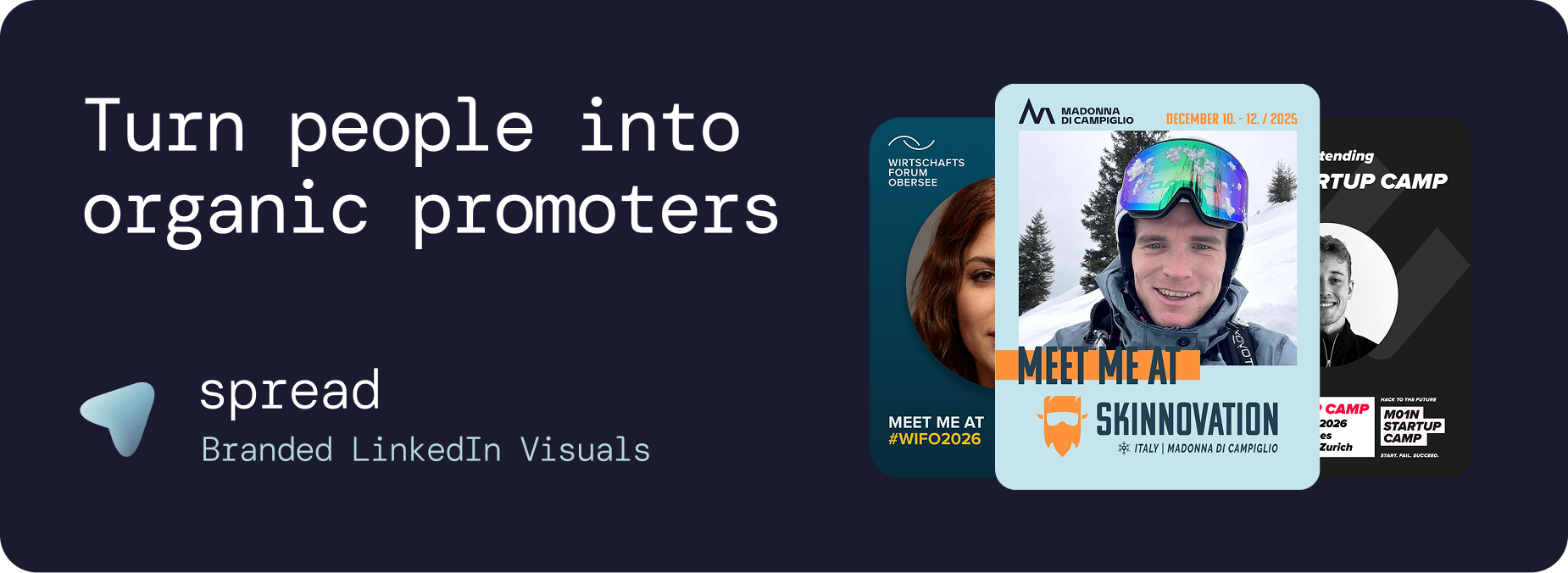
Go Spread is a social attendee advocacy platform built for events, communities and corporate campaigns that need organic reach without paid media. Organizers upload one branded graphic template, share a single public link, and every attendee personalizes their own visual with a photo (or their LinkedIn profile photo), and where the organizer adds them, custom text fields. They then download it or share it directly to LinkedIn with a prepared caption, in a few steps and with no account required.
Go Spread
Create branded Meet Me Visuals your audience personalizes and shares on LinkedIn. Organic marketing set-up in minutes.
Photo editing happens in the attendee's browser, and agencies and enterprise clients can run campaigns under their own subdomain and branding with the White Label add-on. More on the full feature set below: this is the tool we build and the one we recommend for anyone serious about organic advocacy for events.
2. Im-Attending.com
Im-Attending is a lightweight tool that lets attendees confirm attendance and generate a shareable "I'm attending" graphic for LinkedIn and other networks. It's simple, focused on the announcement moment, and works well as a quick pre-event awareness nudge. Great for smaller events that need a fast way to get social proof going.
3. Meetmevisuals.com
Meetmevisuals lets organizers create branded meeting and event visuals that attendees personalize and share. It's the historical predecessor of Go Spread and shares the visual-first DNA. Go Spread evolved from this foundation into a broader attendee, speaker and partner advocacy platform with white label and analytics built in.
4. Gleanin
Gleanin describes itself as a Community Marketing platform that helps event organizers attract more attendees by tapping into the trusted communities of their stakeholders. Organizers create campaigns from templates or their own design, can upload speaker data from Excel to create banners automatically, and share campaign links with speakers, sponsors, exhibitors and attendees, who share the content to social channels. Its reporting shows which content drives engagement and ticket sales. Plans and current prices are on gleanin.com; we also put both tools side by side on Gleanin vs Go Spread.
5. LiveDab
LiveDab is an event marketing platform that lets attendees generate personalized visuals and share them across social channels including LinkedIn. It's positioned around badge-style graphics and social proof for conferences and expos. Organizers get a branded microsite and shareable assets that attendees can personalize.
6. InGo
InGo is a social event marketing platform focused on peer-to-peer registration and social amplification. It integrates with event registration systems and encourages attendees to invite their networks, using their social graph to drive ticket sales and event visibility. It's used by larger B2B trade shows.
From the field:
The strongest results we see come from organizers who put the sharing link inside the registration confirmation email and in a mail one week before the event. That's the moment of peak motivation, and completion goes up noticeably when the flow takes only a few steps.
Why we built Go Spread as an attendee advocacy platform for LinkedIn reach
Go Spread was built because we ran events ourselves and got tired of watching big marketing budgets underperform a single personal post from a well-connected attendee. LinkedIn's own research shows employee posts get roughly 8x the engagement of company page posts, and yet almost no event tooling treats attendees as the primary distribution channel. Go Spread is designed end-to-end around that insight.
The attendee experience: a few steps, no login
The moment an attendee opens the Go Spread link, they upload a photo (or use their LinkedIn profile photo), see their personalized branded visual live, and download it or share it to LinkedIn with a pre-written caption. No password, no account, no app install. That is why 40 to 60% of people who open a Go Spread link download the graphic: the simple flow is the biggest driver of results.
The organizer experience: setup in a few minutes
Upload one branded graphic (a regular image or a transparent PNG), build one in the Design Editor, or import your branding from your event website
Configure the photo area, logo spot, text fields and captions
Share the public link in registration emails, chat groups and speaker briefings
Follow the analytics: views, downloads, direct LinkedIn posts and estimated impressions

Go Spread Event Marketing Attendee Advocacy Social Sharing
What Go Spread includes
Flexible personalization: mix and match photo areas, logo spots and custom text fields per graphic
LinkedIn photo auto-fill: attendees can use their LinkedIn profile photo instead of uploading one
Multi-graphic campaigns: one campaign can have several graphics for speakers, sponsors, exhibitors and attendees
Folders: group related campaigns under one parent event
Analytics: views, downloads, direct LinkedIn posts, performance per graphic and estimated impressions
White label add-on: run campaigns on your own subdomain with your own branding, or an agency client's
Proven organic reach
In our analyses of past partner campaigns, 100 attendee posts generated 250,000+ organic LinkedIn impressions. Buying that reach through paid social would cost a lot, and organic posts have an extra advantage: they are personal, native and posted by real people in the relevant network.
Tip: the best attendee advocacy campaigns don't stop at attendees. Add speaker advocacy templates for keynote announcements, partner advocacy graphics for sponsors, and employee advocacy variants for your own team. Every audience gets its own personalized asset.

Go Spread Meet Me Visuals Examples
Beyond attendees: Speaker, Partner, and Employee advocacy
The same Go Spread engine that powers attendee advocacy handles every adjacent use case. Once you've built the muscle for organic distribution, you can turn it on for any audience your event, brand or organization touches.
Speaker advocacy: personalized "I'm speaking at" graphics that keynotes post weeks in advance
Partner advocacy: sponsor-branded visuals that partners can co-market with
Employee advocacy: team member templates for product launches, hiring pushes and company milestones
People advocacy: community members, alumni and ambassadors sharing branded personal moments
Organic advocacy: zero paid spend, algorithm-friendly LinkedIn content at scale
Digital advocacy for events: the full pre-event, live and post-event distribution loop
Who uses Go Spread: Event Organizers, Agencies, Communities, Corporates
Besides event organizers, Go Spread is used by three main organizer types, each with a slightly different playbook.
Agencies
Marketing and event agencies use Go Spread as a productized service they can add to every client engagement. With the White Label add-on and per-campaign branding, an agency can run several attendee advocacy campaigns at once without any client seeing the Go Spread brand, and setting up a new campaign takes far less time than a custom build. We describe the agency workflow in more detail in event marketing agency software for social kits.
Communities
Meetup organizers, membership networks and professional communities use Go Spread to keep the LinkedIn drumbeat going year-round. Every event, workshop and member spotlight becomes a shareable branded asset, which compounds the community's visibility without any of the members feeling like they're doing marketing work.
Corporates
Corporate marketing and internal communications teams use Go Spread for product launches, sales kickoffs, town halls and DEI initiatives. Because attendees don't need an account, the internal friction that usually kills employee advocacy programs disappears.
White label attendee advocacy for agencies and enterprises
Go Spread's white label add-on is built for the reality that agencies and enterprise clients often cannot show a third-party vendor's logo on public-facing campaigns. Once it is active, every campaign runs on your own subdomain (for example share.yourcompany.com), and all share links and QR codes use it. Your logo replaces the Go Spread branding in the footer.
For agencies, this means every campaign looks like an in-house build. For enterprises, it means brand governance stays intact even at scale.
GDPR and privacy questions to ask
Every serious European organizer needs to answer the same questions before onboarding an attendee advocacy platform:
Is there a signed DPA?
Are uploaded photos processed in the browser or stored on a server?
Where is the data hosted?
What's the stated retention period?
Where does explicit consent get captured?
For Go Spread: photo editing and the final image are created in the attendee's browser, and the normal download flow does not upload the photo. When an attendee connects LinkedIn to post directly, a temporary copy of the photo is kept privately for the sign-in round trip and deleted within about an hour. Analytics use anonymous session IDs, with no names, emails or photos. For a DPA or detailed legal questions, contact the team directly.
Get started with an attendee advocacy platform for your next event
If you're planning an event, product launch or community campaign in the next few months, the fastest way to see whether attendee advocacy works for you is to run one campaign end-to-end. Go Spread's self-serve setup takes minutes, the attendee flow takes a few steps, and you'll see the first views and downloads as soon as the link is out. Whichever platform you choose in the end, the important step is committing to organic advocacy for events as a first-class channel, not an afterthought. Start your first Go Spread campaign for free.